1.

What if nature disappeared and had to be reconstructed via entirely human-made processes?

2.

What would art look like if we had never seen nature or only remembered it from long time ago?

3.

How does memory, physical perception and life stage impact our relationship to nature?

4.

Do we have the tools and the capacity to capture the world around us?

5.

How does nature shape our identity and sense of belonging?

6.

If technology is so fundamental to life, what is then natural?

7.

Is there a divide between human, nature and device?

8.

Is digital memory superior to biological memory?

9.

What values are reflected in the way we refer to nature?
(E.g. mother nature, an almighty deity, a community of spirits, an environmental background, a resource, a functioning system.)

10.

What is the cost and impact of femininity?
(E.g. in art, in nature, across culture, in personal and professional life.)

11.

What is the role of tradition in contemporary art?

12.

Does post-digital culture suffocate or revitalize traditional art?

beyond opposites

“In Western culture, we are conditioned to organize meaning through oppositions, i.e. to see differences as incompatibilities.

The following tropes probably sound familiar: nature vs. technology, humans vs. machinery, tradition vs. modernity, rationality vs. intuition. Handmade vs. machine-made, order vs. spontaneity, methodology vs. serendipity, dynamism vs. stillness, beauty vs. intellect, etc., etc.

But what if these apparent opposites are not mutually exclusive? What if they are false dilemmas that limit instead of facilitate human freedom? My art exists to question these binaries.

I see technology as a way to preserving nature. Devices are extensions of human intention. Historical arts and crafts are inspiration for modern digital systems, while intuition is the starting point for designing a procedure. To me, authorship is a continuous phenomenon across the unaided hand and all the tooling that this hand can create to enhance itself.

Structure provides the fertile ground for surprise — think of poetry forms and musical scales, chess rules, or scientific experiments. Constraints can generate innovation. A static image can become a journey, if it activates the imagination of the explorer.

I reckon, sensory pleasure is not the opposite of critical thinking. In fact, it is frequently the gateway to it. You might approach the art for its visual appeal but the reason you stay is the deeper inquiry.

In my art, my goal is not to choose sides and because of this my work may frustrate the natural human desire to sort things into clear-cut categories. I am interested in what is possible when opposites are not treated as enemies, when answers are not limited to either-or, when meaning emerges through a constructive exchange rather than premature exclusion.

I want to see what the world looks like when all objects in it are ‘made of both truths’, and possibly even a third component in addition. My message is: promote symbiosis and not artificial dichotomies.”

— Iris Sylv on creative thinking

what is reflections?

Reflections is my latest project in ‘computational herbalism’ — a form of art I founded myself, at the intersection of nature and constructed systems.

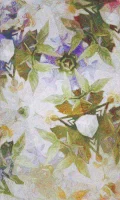
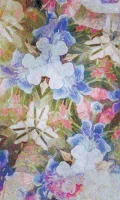
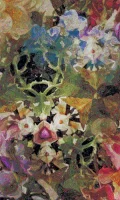
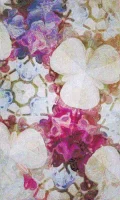
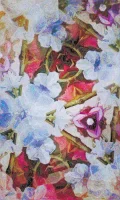
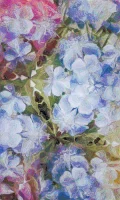
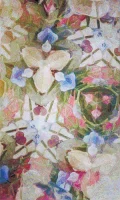
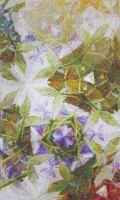
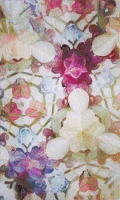
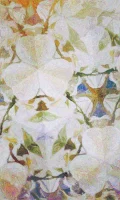
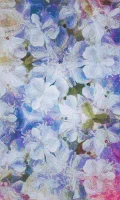
The project revolves around a conceptual framework of 12 discussion-provoking questions. It encompasses 4 series of 12 visual artworks, where each work is an experiment from seed to garden.

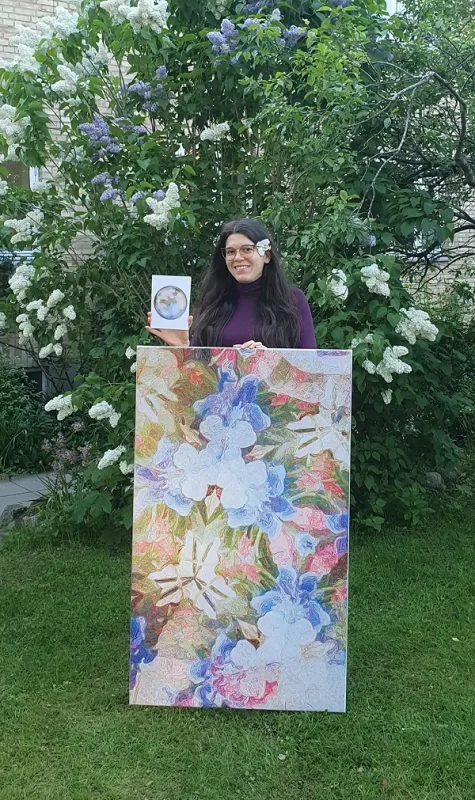
A seed is an impression gathered from a personal photo or a walk in nature, accompanied by a kaleidoscope, a magnifying glass or binoculars. I first hand-paint the seed on a digital tablet and then develop it through a multi-step post-digital process to arrive at the final artwork, or ‘the full garden’.

To create the garden, I interact with a piece of painting software that I hand-coded myself, and that helps me translate artistic ideas into algorithmic structures. Inspired by impressionism, pointillism and the physics of light, this experimental process helps me produce various alternative outcomes for each seed and explore the space between intuition, technology and chance.

I select one result from each experiment and refine it through manual color grading and layering. The resulting post-digital painting is materialized as a limited edition of 6 (archival ink on high-weight cotton canvas, that gives its natural texture to the work). The starting seed for each work accompanies it in the form of a fine art postcard.

Each painting can be enjoyed from three viewing distances, exploring the three stages of human growth — childhood, adolescence and adulthood. Up close it appears as intricate linework of 120-150 thousand individual strokes. At mid-distance, a triangular, almost crystalline structure emerges. From afar, flowers and plants dominate. Moving between these perspectives, the viewer can take a journey between the life stages — starting from absorbing vast amounts of unstructured input (childhood), to recognizing some of life’s patterns (adolescence), to finally finding meaning beyond the apparent (adulthood).

Across history, herbalism has been both sought after for healing and prosecuted as witchcraft. Today, complex code occupies a similar space — it can be admired for its problem-solving power or misunderstood and dismissed as ‘black magic’.

Specialized domains rarely exist without judgement, especially when a practice is carried by women. To honour the work of those who take care of people and things in such ambiguous spaces, I name my paintings after female caretakers. The exact names are fictional for privacy reasons, but they are strongly associated to women whose story I have encountered and who have moved me.

The works reflect my personal responses to the guiding questions and serve as a starting point for a discussion with the audience. The reactions and interpretations of the audience are even more important than consuming the imagery itself.

Series 1 of the project is complete and Series 2 is in progress. Series 3 and 4 are planned for the upcoming years.

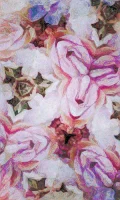
Iris Sylv - painting, seed, lilacs